ST-GDance++: A Scalable Spatial–Temporal Diffusion for
Long-Duration Group choreography
Jing Xu1,
Weiqiang Wang1†,
Cunjian Chen1†,
Jun Liu2,
Qiuhong Ke1
1Faculty of Information Technology, Monash University, Melbourne, VIC, 3800, Australia.
2School of Computing and Communications, Lancaster University, Lancaster, LA1 4YW, UK.
†Corresponding author.
Abstract
Group dance generation from music requires synchronizing multiple dancers while maintaining spatial coordination, making it highly relevant to applications such as film production, gaming, and animation. Recent group dance generation models have achieved promising generation quality, but they remain difficult to deploy in interactive scenarios due to bidirectional attention dependencies. As the number of dancers and the sequence length increase, the attention computation required for aligning music conditions with motion sequences grows quadratically, leading to reduced efficiency and increased risk of motion collisions. Effectively modeling dense spatial–temporal interactions is therefore essential, yet existing methods often struggle to capture such complexity, resulting in limited scalability and unstable multi-dancer coordination. To address these challenges, we propose ST-GDance++, a scalable framework that decouples spatial and temporal dependencies to enable efficient and collision-aware group choreography generation. For spatial modeling, we introduce lightweight distance-aware graph convolutions to capture inter-dancer relationships while reducing computational overhead. For temporal modeling, we design a diffusion noise scheduling strategy together with an efficient temporal-aligned attention mask, enabling stream-based generation for long motion sequences and improving scalability in long-duration scenarios. Experiments on the AIOZ-GDance dataset show that ST-GDance++ achieves competitive generation quality with significantly reduced latency compared to existing methods. Code will realse after acceptance.
Compare with others
(a) In GCD, body overlap between the purple and blue dancers appears in the middle portion of the video, while occlusion between the yellow and green dancers becomes noticeable in the latter half. (b) TCDiff also exhibits mild body overlap between the purple and blue dancers in the later part of the video.
Ablation Comparison
Without the Triangular Noise Schedule (TNS), the motions of different dancers become overly similar and lack individual variation. Without the Alignment Attention Mask (AAM), the motion no longer follows the musical rhythm—under strong, fast-tempo music the dancers still perform large, loosely-timed movements that do not hit the beats. Without the Spatial Modeling Block (SMB), dancers frequently exhibit limb collisions and inter-body penetration. The full ST-GDance++ produces diverse, on-beat, and collision-free group choreography.
Framework
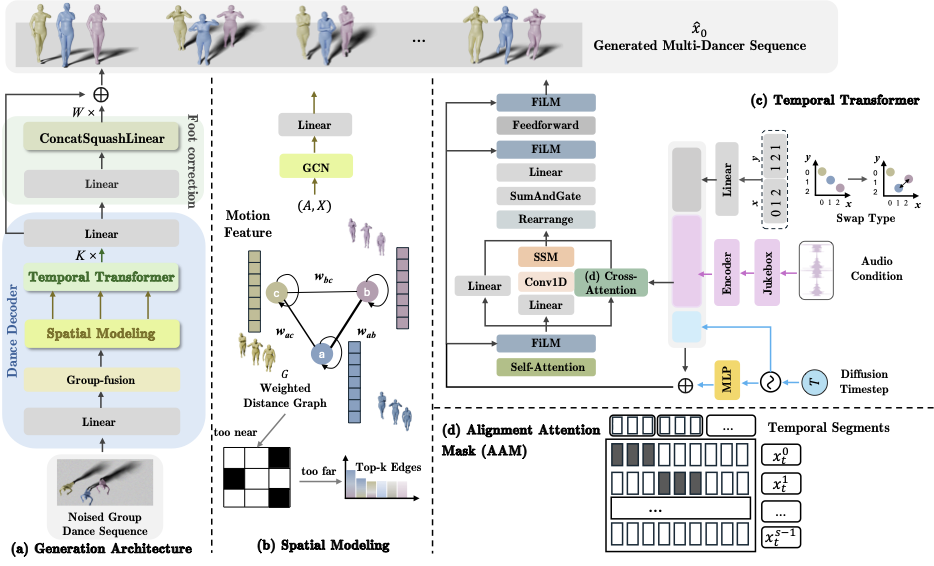
Our method comprises three components: (1) lightweight multimodal adapters that condition not only on music but also on inter-dancer motion and text to enable interactions and inject group semantics, (2) a pair-wise training strategy that enables scalable synthesis, and (3) training-free diffusion-based global optimization that refines spatial coordination at inference.
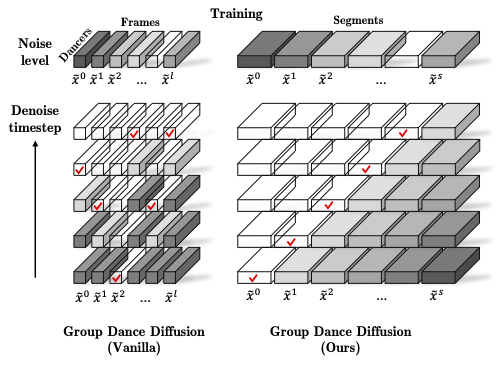
Segment-based triangle noise triangular. Diffusion Forcing typically samples training schedules with stochastic active windows, leading to a noticeable discrepancy between training and inference. To bridge this gap, we introduce a segment-based triangular schedule that exclusively denoises the current active window before advancing. By applying a consistent noise level to all frames within a single segment, our approach ensures temporal coherence and enhances the stability of long-duration generation.